
A Calling, Not Just a Career: the Field of Ministry
An Informational Interview by: Sarah Hampton

Image taken by Sincerely Media
As a senior in college nearing graduation and trying to figure out what I want to do with my degree, I’ve had to answer the questions, “What career field am I going into?” and “What am I doing with my life?” For a while, I didn’t have the answers. During my sophomore year of college, I completely changed my mind about what my major was going to be and realized that I no longer felt passionate about being an English teacher or studying English education. After changing my major to English, I had no clue what I was going to do career-wise until I was accepted into an internship position at my church. Through this internship, I feel that I’ve discovered my calling and the career field I want to pursue: vocational ministry. Recently, I had the privilege of interviewing someone I look up to who is currently working in the field of vocational ministry.
When discussing ministry with other Christians, nine times out of ten, the topic is “serving.” It’s a common belief that serving is good, whether in a church setting, for a nonprofit, or with an organization, because “the Son of Man (Jesus) did not come to be served, but to serve...” (Matthew 20:28, NIV). However, some Christians feel as though they have been “called” to work in the ministry field.
Vocational ministry is a broad field that includes many types of faith-based work, such as being a pastor, serving on church staff, working as a full-time missionary, or creating faith-based content for a religious organization. As Christians, we are all called to minister to others, but that doesn’t mean every Christian must work in vocational ministry. John Mark Comer explains this idea beautifully in his book Garden City. He discusses how our lives as Christians are ministry, that being a shoemaker or a teacher can be ministry, too. He writes, “Our job is to make the invisible God visible—to mirror and mimic what he is like to the world. We can glorify God by doing our work in such a way that we make the invisible God visible by what we do and how we do it.”
The Interview
Learning about this intentionality helped me understand what makes a truly great leader. Jordan is beloved because she is intentional, caring, selfless, relational, organized, and, above all, centered on Jesus in everything she does.
By the end of this interview, I had learned so much about what it means to work in ministry, specifically in a groups director position, but I also gained a clearer picture of what it takes to be a great leader and just how wonderful of a person Jordan Castardi truly is.
Article version below:

Image of Jordan Castardi
Jordan Castardi has been on staff at Woodstock City Church for eight years. Before entering ministry, she worked in the corporate world. She also attended and graduated from Kennesaw State University. While attending KSU, she met her now husband, who also works at Woodstock City Church, and together they have two children. When Jordan first started at Woodstock City, she worked on a different team before eventually becoming the project manager for The Living Room, the church’s college ministry. More recently, she transitioned into the role of groups director for The Living Room. Her acceptance of this new role is one of the main reasons I wanted to interview her, in addition to her being my supervisor for my internship. When it comes to my own career in ministry, I would eventually like to become a groups director as well.
What is the difference between ministry and vocational ministry?

Image taken by Sarah Hampton
So, if you are called to teach high school students or to be an engineer and help design buildings, do it. Our lives themselves are ministry, but some people are called specifically to vocational ministry, such as Jordan Castardi, the college groups director I had the privilege of interviewing for this article.
I was able to meet with Jordan on Monday, November 10. Our meeting was not as formal as some may think. Thanks to our pre-existing coworker relationship, I was able to interview her in the middle of our work day. I first started off the interview by asking questions that revealed who she was as a person and what her motivations were.
The first question I asked Jordan was about what career field she was in before going into ministry and how she knew she needed to pursue a career in it. The goal behind this question was not only to gain more insight into who she is as a person and what motivates her, but also to better understand what it means to be “called” into ministry and what that looked like for her. She explained that before working in ministry, she was employed in the corporate world. At the time, her husband was already working at Woodstock City Church, and she began to notice many differences between her corporate team and his ministry team. She talked about what she values most in a career, putting family first, working with a team that prays together, and being part of a group that encourages spiritual growth. These qualities drew her toward working for a ministry team, especially at Woodstock City Church. After realizing this, she decided to make the switch. Her answer gave me valuable insight into what a healthy versus toxic team and work environment looks like, and it reminded me how important it is to have strong values and to genuinely enjoy the career you’re in.
I then asked Jordan a few questions focused on what she does in her role as groups director. Some of the questions were aimed at gaining a better understanding of what a groups director actually does, but my favorites were the ones that dove into the more challenging aspects of the role. One of my favorite questions was, “What keeps you motivated during the hard moments in your career?” Jordan responded, “I remember the why. If you are going to have hard conversations, remember the big picture. Also, remember that people’s experiences determine their view on things. Be curious about what people’s experiences are, and don’t be so set in your ways.”
This was such great advice for me, someone who cares deeply about what others think, because if I want to go into a groups director position, I know there will be difficult conversations, and I can’t take everything to heart. People are going to have their own opinions and beliefs, and I need to stay open-minded to hearing them.
Another question I really enjoyed asking her was, “What advice would you give someone who wants a career in groups directing?” She responded by talking about the importance of balancing relational skills with organizational and systems-based skills. If you are naturally people-oriented, you’ll likely thrive in this career, but she warned against focusing too much on relationships alone. Many group leaders appreciate having systems and processes in place to help them be led well. Without these structures, you can easily come across as disorganized. This was very helpful advice for me once again, because I’m naturally very people-oriented, but I sometimes get so caught up in the relational side of things that I forget to establish systems and can become disorganized.
“I remember the why. If you are going to have hard conversations, remember the big picture. Also, remember that people’s experiences determine their view on things. Be curious on what people’s experiences are and don’t be so set in your ways.”
— Jordan Castardi (answering the question, “What keeps you motivated during the hard moments in your career?”)
Overall, this interview process was both revealing and helpful, not only for my own career pursuits but also for getting to know my supervisor better. I have worked with Jordan Castardi for almost two years now, and during that time she has guided me in growing not only spiritually but also personally and professionally. If it weren’t for her encouragement and leadership, I wouldn’t be pursuing a master’s degree at a seminary or considering a career in ministry. If I am ever in a groups director role, I aspire to lead like Jordan. Her leadership and discipleship skills are inspiring and unmatched.
One question from the interview that I hadn’t mentioned earlier was, “What is your favorite part about your job?” Her answer gave me even more insight into who she is as a person. She said that her favorite part of her career is having conversations with the leaders she leads. She also shared that she loves inspiring leaders in their faith. Jordan’s faith in Jesus has motivated me to follow Him with my whole life, and it continues to inspire others as well. I’ve also seen how resourceful she is when it comes to connecting the weekly sermon from The Living Room to outside sources and Scripture for her leaders. Most importantly, I learned how deeply she cares for each leader she works with. She told me that she regularly asks how she can pray for them and intentionally follows through, remembering the specific things they’ve asked prayer for and lifting them up often.
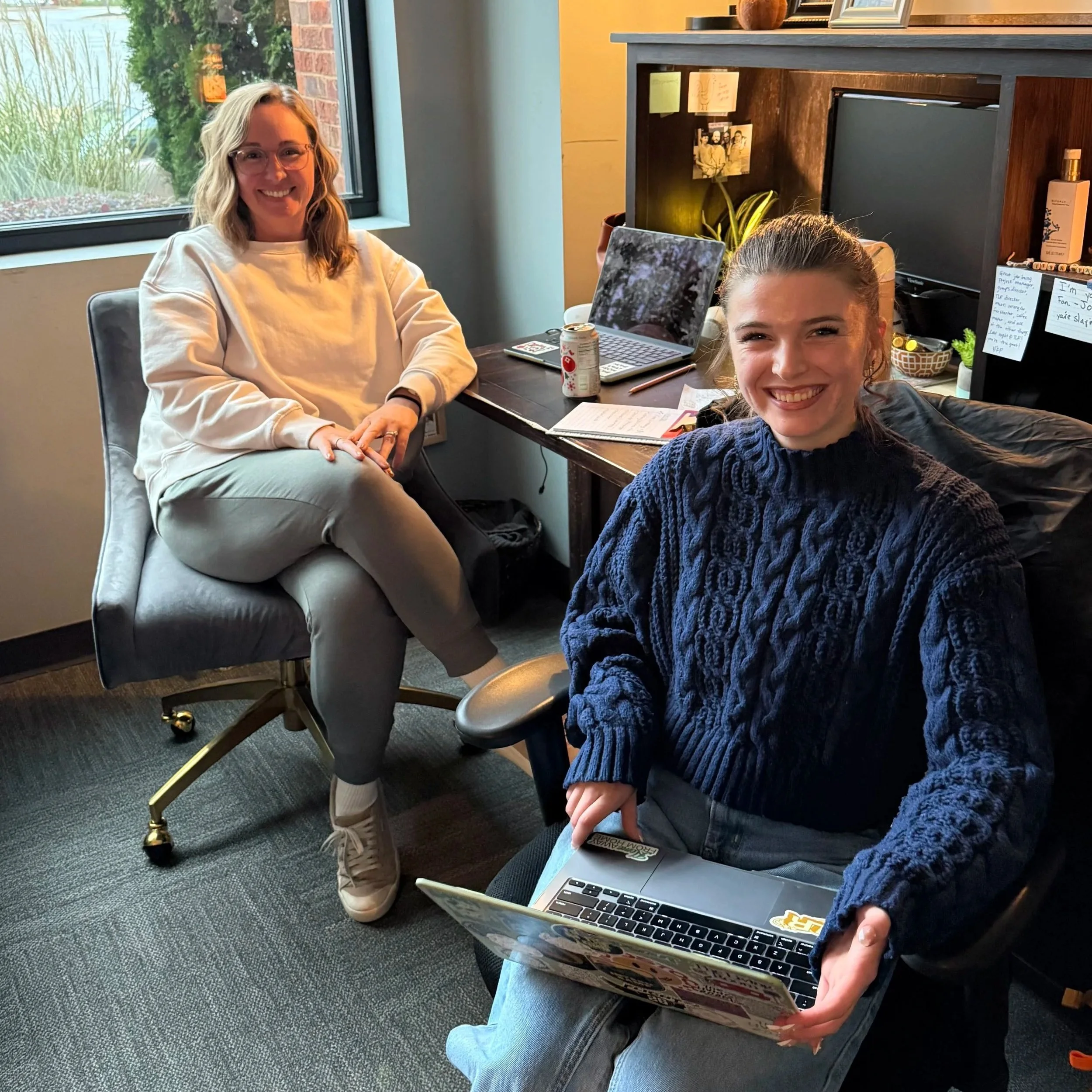
Image of interview